

Why Properties in Dorchester Can Move
Dorchester contains historic stone buildings, Georgian and Victorian properties, twentieth-century housing and newer residential developments. Each type of building responds differently to changes beneath its foundations, particularly where alterations or extensions have introduced additional materials and structural connections.
Changes in soil moisture, defective drainage and leaking underground services can affect the ground supporting a property. Mature vegetation may also need to be considered where roots and seasonal moisture changes are close to foundations. In other cases, poorly compacted material beneath an extension, shallow foundations or deterioration within older masonry can contribute to visible movement.
Some defects may be caused by individual building components rather than subsidence. Cracking above an opening, for example, can sometimes indicate lintel failure, while bulging masonry may relate to inadequate restraint. At ASRS Ltd, we review the wider pattern of damage so that the recommended repair addresses the actual structural problem.

Assessing Cracks and Structural Distortion
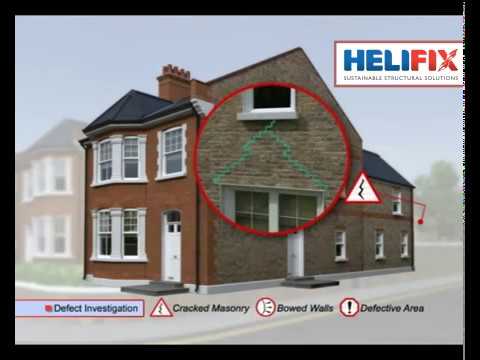
The shape and position of a crack can provide useful information about how a building has moved. Stepped cracks through brickwork, irregular separation within stone walls and diagonal cracks extending from doors or windows can indicate differential movement. Gaps may also develop where an extension, porch or adjoining structure has moved independently from the main property.
Internal signs can include doors that no longer close correctly, window frames becoming distorted, sloping floors and cracks passing through wall finishes. External walls may begin to bow or separate from floors and roof structures. Where retaining walls form part of the site, movement can appear as leaning, rotation or horizontal cracking caused by changing ground pressure or inadequate drainage.
ASRS assesses these symptoms together before recommending work. The repair may involve Helifix crack repairs, masonry reinforcement, lateral restraint, ground anchors or additional foundation support. We also undertake concrete repairs in Dorchester where concrete components have deteriorated or been affected by movement.

Helifix
Approved Installer
As an approved Helifix installer, ASRS provides a wide range of repair techniques that can be combined to produce the best solution for your structural problems, from wall cracking to foundation sinking. They include the Helifix systems, Anchor Systems’ ground anchors and micro piles, Cintec sock anchors, and various concrete repair products.

First-class service

I would just like to pass on what a first-class service I received from your company. All the guys who attended, and Gary the Surveyor, were absolutely fantastic. I am so pleased with the work that was carried out.
LG – Witney, Oxfordshire
Professional attitude
I wanted to let you know that we were very pleased with the work, professional attitude, care and attention of the builders who worked on our property. Thank you.
PT – High Wycombe
A credit to ASRS
The team is a real credit to ASRS. Nothing was too much trouble. They took the time to explain what they were doing. Show the works as they were being progressed and left the area very clean and tidy.
LH - Milverton
A pleasure to deal with
Thanks for the work which - as far I can tell - was carried out to a high standard, and which started and finished on time and on budget.
I’d also like to put on record our appreciation of Lee who managed the job. He was careful and thorough, always professional in his approach and was a pleasure to deal with throughout.
TR – Aller, Somerset
Efficient and skilful
Thank you so much for the incredibly efficient and skilful way in which the structural repair work was carried out at my property.
I was particularly reassured by the team who carried out the work and kept me updated on what was happening.
BW - Bristol
Call us for help with any of these
Common structural defects, issues and problems

We offer free site visits to both domestic and professional clients to assess the problem and propose the appropriate repair programme, tailored to suit the specific needs of the project. ASRS are approved installers of the Helibeam System, offering cost effective, non-disruptive and concealed solutions to all aspects of remedial masonry stabilisation. Our skilled installation teams are trained and experienced in all aspects of masonry repair. They have been trained to the highest standard in every installation process to cover all H+S requirements. With most of our design and installation specifications we are proud to offer a 10yr indemnified guarantee on Helifix repairs and Micro Piling. We offer a 25yr guarantee for Wall Tie replacement.
Reasons
To trust ASRS

Free Quotation

Helifix Approved

Skilled Workforce

Guaranteed

Repair Methods Matched to the Building
Every subsidence repair project begins with an assessment of the damage and the structural arrangement of the property. ASRS considers how loads pass through the walls and foundations, whether cracks remain active and how different sections of the building are connected. Drainage, vegetation, surrounding levels and previous alterations may also influence the proposed work.
Where further technical investigation is necessary, we can work with structural engineers, building surveyors, insurers and loss adjusters to establish a suitable specification. Cracked masonry may be strengthened using stainless steel reinforcement installed within selected mortar joints. This can reconnect separated sections and restore continuity without requiring the wholesale rebuilding of sound stonework or brickwork.
Where movement originates beneath the foundations, micro piles may be used to transfer structural loads to more stable ground. Ground anchors and lateral restraint systems can address movement in retaining walls or external elevations. The final programme may combine several techniques according to the defects identified.
Experienced Structural Repair Teams
ASRS brings together expertise in masonry reinforcement, foundation support, concrete repair and structural stabilisation. This enables us to address related defects through one coordinated programme rather than treating each visible symptom separately.
As an approved Helifix installer, we can install concealed reinforcement designed to strengthen damaged masonry while preserving the appearance of serviceable walls. This can be particularly valuable for Dorchester’s traditional buildings, where retaining original materials may be an important consideration. Modern homes, apartment buildings and commercial premises can also benefit from targeted repair systems that reduce unnecessary demolition and disruption.
Our trained teams complete installations in accordance with the agreed specification and maintain safe working areas throughout the project. We explain the proposed process clearly and coordinate with homeowners, property managers and professional advisers where required. Access, occupancy and existing finishes are considered when planning the work, helping us deliver an appropriate structural repair with dependable workmanship from the initial assessment through to completion.
